
Why OG Whales Sell
By Bitcoin Fortress - Nick Reichert

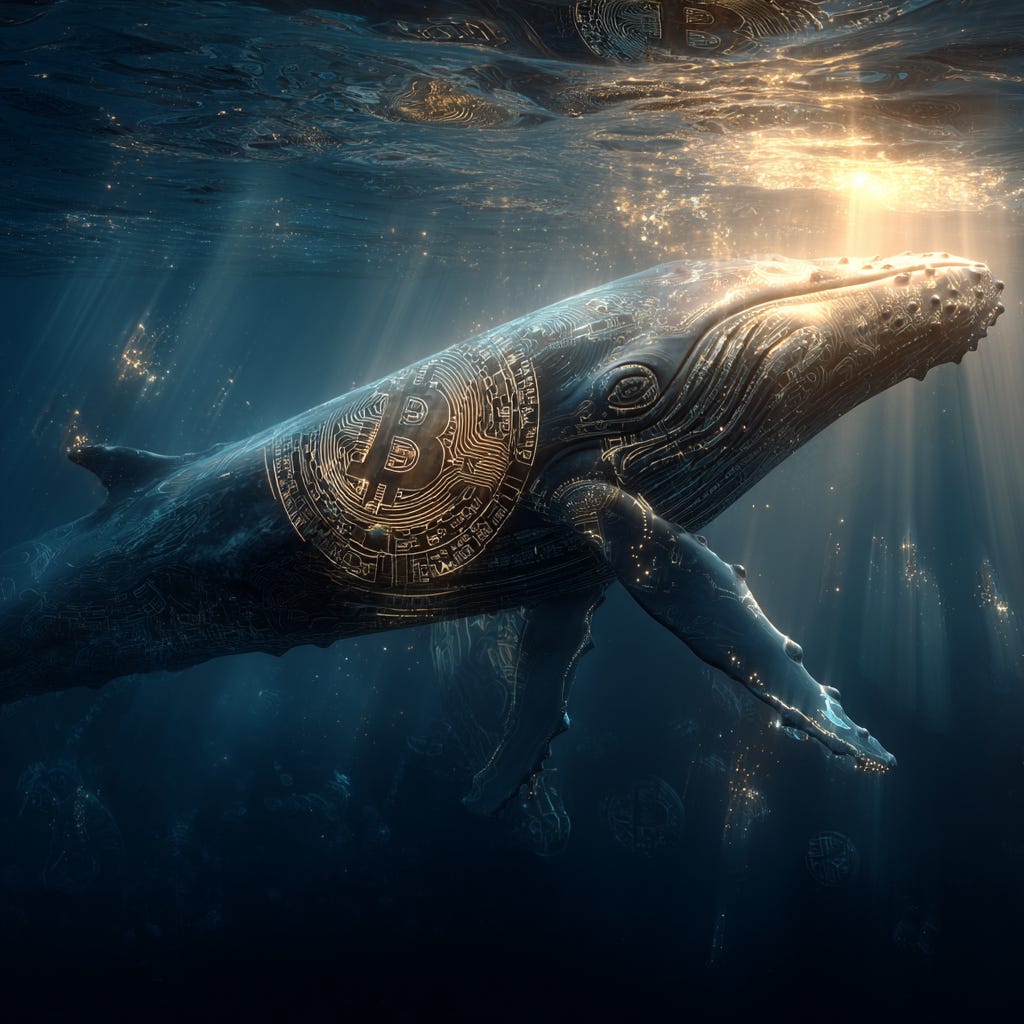
Understanding the psychology, incentives, and life cycles of early Bitcoin holders
Bitcoiners love to mythologize “OG whales” — the early miners, cypherpunks, pioneers, and lucky degenerates who stacked five, or ten, or fifty thousand BTC before the world caught on. We often imagine them as diamond-handed monks who will take their stash to the grave like digital pharaohs.
But OG whales do sell.
They always have, and they always will. Not because they’ve lost conviction in Bitcoin, but because they’re human beings navigating real incentives, life cycles, risks, and responsibilities. And understanding why OG whales sell gives ordinary stackers something far more valuable than gossip: a deeper grasp of Bitcoin’s long-term game, the maturity of the asset, and the incentives that drive a healthy market.
Below are the real reasons — the ones no one wants to talk about — why the earliest and largest Bitcoin holders eventually off-load coins.
1. They Were Never “Bitcoin Maxis” — They Were Just Early
Some early holders weren’t ideological pioneers. They weren’t reading The Sovereign Individual or lurking on Cypherpunks. They were:
miners who stumbled onto a curiosity
early exchange operators
devs paid in BTC
opportunistic traders
gamers who forgot about a faucet wallet on an old laptop
For many of them, Bitcoin wasn’t a religion — it was an experiment, a toy, or an arbitrage trade. When the number on the screen went parabolic, they did the rational thing: they took profit.
They sell because their thesis was fulfilled long ago.
2. Concentration Risk Becomes Terrifying at Scale
Holding 10,000+ BTC at $1,000 is quirky.
Holding 10,000+ BTC at $100,000 is existential.
When your net worth hits nine or ten digits, something changes:
You realize you’re one hardware failure away from generational ruin.
You worry about personal safety.
Your time preference subtly shifts.
You start asking, “Do I really want 99% of my net worth in one asset?”
Even the most convicted Bitcoiners feel the gravity of concentration risk when their stash becomes a treasury.
This is the paradox of early adoption: the people who took the biggest risk now hold the most asymmetric positions. Selling is often less about “losing faith” and more about risk management at extreme scale.
3. Life Happens — Even to Whales
OG whales are not internet legends floating in cyberspace. They age. They get married. They have kids. They go through divorces. They buy homes. They fund startups. They pay medical bills. They become philanthropists. They sometimes just want a different life.
Bitcoin is the most pristine collateral ever invented, but it is not a replacement for:
Closing a business deal
Paying for a child’s education
Settling an estate
Covering legal fees
Buying a house in cash
As Bitcoin matures, whales increasingly tap liquidity not because they are bearish, but because their lives require it.
4. Tax Optimization Makes Selling Rational
Whales think in decades.
If you acquired coins at $10, selling 100 BTC at $100,000 may incur a brutal tax hit — but:
locking in gains
establishing a stepped cost basis
funding a DAF
harvesting strategic losses
moving coins into beneficial trust structures
…may justify partial liquidation.
Sophisticated whales sell not because they want to, but because the tax code incentivizes them to.
5. Security Risks Scale Faster Than Wealth
A 50 BTC stacker worries about seed phrases.
A 5,000 BTC stacker worries about:
kidnapping
extortion
violent threats
estate theft
coercion
nation-state targeting
The mythology of the OG whale often misses this simple truth: holding huge amounts of Bitcoin is dangerous.
Many whales sell not because they’re scared of volatility, but because they’re scared of being a target.
A smaller public footprint plus diversified assets reduces risk.
6. They Want to Enjoy Life
People who HODLed from 2010 to 2024 took a ridiculous, improbable, almost mythic journey.
Eventually, many want to:
upgrade their lifestyle
buy property
travel
invest in passion projects
retire
build a legacy
live their life without doing mental math every time they spend money
Bitcoiners talk about “low time preference,” but low time preference doesn’t mean denying yourself forever.
Fulfillment is part of the plan.
7. They Become Stewards, Not Hodlers
The OG who mined Bitcoin on a laptop in 2011 is not the same person today.
Over time, many whales evolve from “HODL forever” to:
founders of Bitcoin startups
angel investors
educators
philanthropists
infrastructure builders
developers
ecosystem mentors
A whale selling 500 BTC to fund 10 Bitcoin businesses is a net positive for the network.
OG whales sell because their role shifts from individual wealth accumulation to ecosystem contribution.
8. Some Simply Lose Access — Permanently
This is the tragic reality.
Not every whale sells. Some disappear.
Laptop failures, lost seed phrases, forgotten hard drives, old wallets on dead machines — a meaningful portion of OG coins are gone forever.
Ironically, this reduces sell pressure across the entire market and makes selling even more rational for the whales who still have access.
9. The Market Needs Sellers — That’s How Bitcoin Matures
Even Bitcoin needs a circulatory system.
Without sellers:
price discovery stops
liquidity evaporates
volatility spikes
adoption slows
institutions stay sidelined
Whale selling is part of the natural maturation of an asset transitioning from a fringe experiment to a global monetary standard.
Markets work because participants behave differently at different stages of the cycle.
10. They Know the Endgame — and They’re Positioning for It
The most philosophical reason OG whales sell is also the most powerful:
They know Bitcoin is inevitable.
Selling 5% today to secure the other 95% for the next 50 years is not bearish — it’s prudent.
Whales sell strategically because:
Bitcoin is becoming global collateral
Traditional markets are migrating toward Bitcoin standards
Institutions are accumulating relentlessly
Nation-states are mining and HODLing
The future monetary system will require throughput, liquidity, and movement
The goal is not to die with the most coins.
The goal is to help Bitcoin win, and to ensure your family and your values survive the transition.
Final Thought: Bitcoin Isn’t Weaker Because Whales Sell — It’s Stronger
OG whales selling is not a sign of weakness.
It’s a sign of maturation.
It means Bitcoin has moved from ideology to infrastructure, from hobby to reserve asset, from experiment to inevitability.
The early holders took the initial risk. The new holders are assuming the baton. And the more Bitcoin decentralizes across generations, geographies, and economic classes, the stronger the network becomes.
As Satoshi wrote:
“Lost coins only make everyone else’s coins worth slightly more.”
Selling, spending, losing, redistributing — all of it is part of Bitcoin’s long story of diffusion.
And the next chapter of that story belongs not to OG whales…
…but to the builders, the educators, the families, and the sovereign individuals stacking today.
Not financial or legal advice, for entertainment only, do your own homework. I hope you find this post useful as you chart your personal financial course and Build a Bitcoin Fortress in 2025.
Bitcoin Fortress Newsletter is a reader-supported publication. To receive new posts and support my work, consider becoming a free or paid subscriber.
Thanks for following my work. Always remember: freedom, health and positivity!
Please also check out my Bitcoin Fortress Podcast on all your favorite streaming platforms. I do a weekly Top Bitcoin News update every week on Sunday, focused on current items of interest to the Bitcoin community. Please check it out if you haven’t already. Also now on Fountain, where you can earn Bitcoin just for listening to your favorite podcasts.
Also, check out my books:
Follow me on Nostr:
npub122fpu8lwu2eu2zfmrymcfed9tfgeray5quj78jm6zavj78phnqdsu3v4h5
If you’re looking for more great Bitcoin signal, check out friend of the show Pleb Underground here.

»»»»»» Twitter | Youtube | Citadel21 | PlebUnderground Swag Shop »»»»»»